
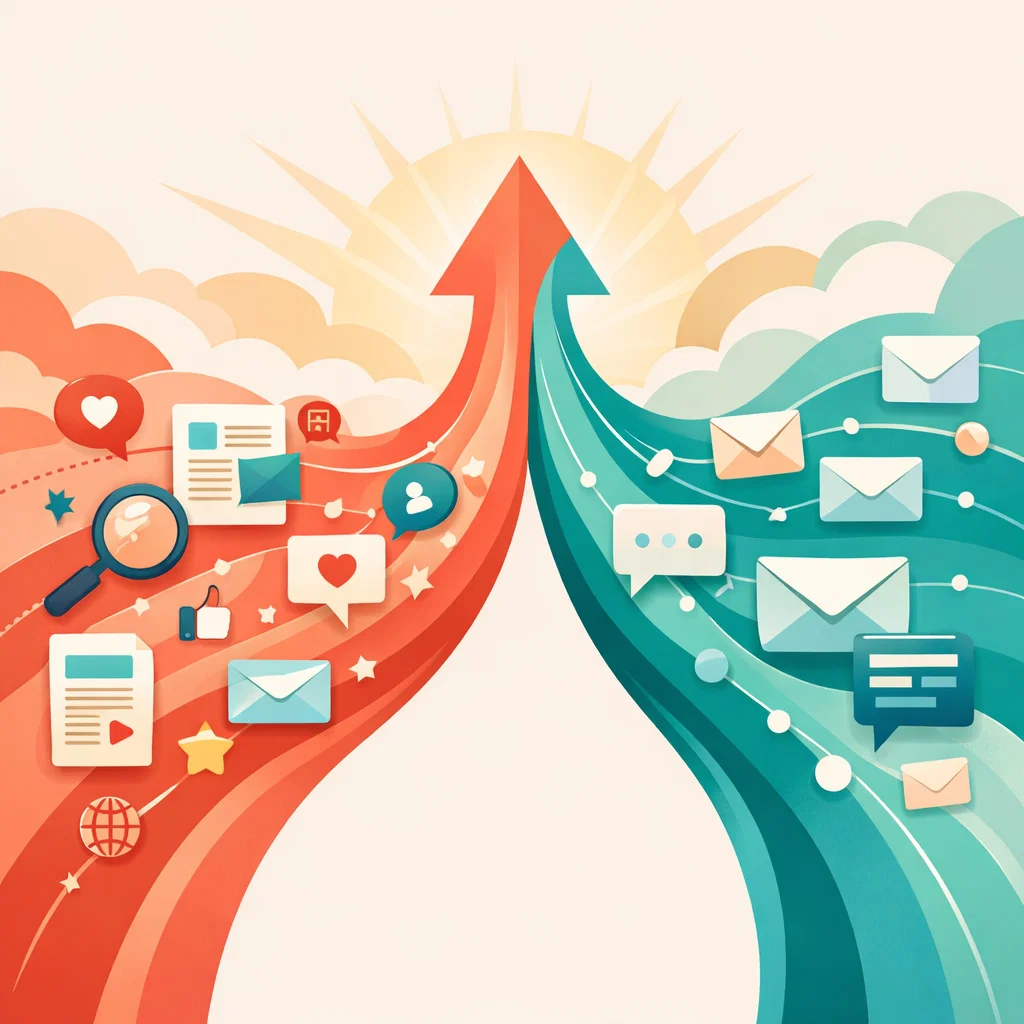

Most people think scaling an online business means running ads, building complicated funnels, or chasing the latest platform trend. In reality, the most stable and sustainable growth often comes from combining two simple systems that already work well on their own: organic traffic and email nurturing.
This combination is what many experienced marketers quietly rely on. It is not flashy, but it is powerful. A hybrid funnel allows you to attract people naturally, build trust over time, and create opportunities for income without burning out or overspending.
Let’s break down how hybrid funnels work, why they are so effective, and how you can start building one without overcomplicating things.
What a Hybrid Funnel Really Is
A hybrid funnel blends organic traffic sources with a structured email follow up system.
Organic traffic brings people into your world. This can include blog posts, search traffic, Medium articles, social posts, YouTube videos, or Pinterest pins. These visitors arrive because they are already curious or searching for something specific.
Email nurturing is what happens next. Instead of sending people directly to offers and hoping for the best, you invite them onto your email list. From there, you guide them with useful information, insights, and small steps that build confidence over time.
Together, these two pieces create a system where traffic keeps flowing and relationships keep growing.
Why Organic Traffic Alone Is Not Enough
Organic traffic is valuable, but it has limitations.
Someone might read one article, get distracted, and never come back. Algorithms change. Platforms update their rules. Even great content can disappear into the noise if there is no follow up.
When you rely only on organic traffic, you are always starting from scratch with each new visitor. There is no memory, no continuity, and no way to deepen the relationship unless they return on their own.
Email fixes that problem.
Why Email Without Organic Traffic Also Falls Short
Email marketing works best when subscribers already have context.
If people join your list without knowing who you are or why they should trust you, every email feels like an interruption. Engagement drops. Open rates fall. People unsubscribe or ignore future messages.
Organic content warms people up before they ever see your emails. It gives them a reason to listen. By the time they join your list, they already understand your perspective and your approach.
That is where the hybrid model shines.
How Hybrid Funnels Create Momentum
A hybrid funnel works like a loop instead of a straight line.
Someone discovers a blog post through search.
They read and click through to a related article.
They opt in for a free resource.
They receive helpful emails that expand on what they already read.
Those emails send them back to more content.
Trust builds slowly and naturally.
Over time, this loop compounds. Your content works even when you are offline. Your emails support your content instead of replacing it. Each piece strengthens the other.
Building the Organic Side of the Funnel
The goal of organic traffic is not volume. It is relevance.
Focus on topics your audience already cares about. Answer questions. Share experiences. Break down complex ideas into simple steps.
Good organic content does a few things well:
- It solves a specific problem
- It sets expectations honestly
- It introduces your way of thinking
- It invites the next step naturally
That next step does not need to be a product. Often, it is just a helpful guide, checklist, or short plan that makes progress feel possible.
Building the Email Nurture Side
Once someone joins your list, your job changes.
You are no longer trying to attract attention. You are guiding someone who has already raised their hand.
Email nurturing works best when it focuses on:
- Clarity over hype
- Consistency over pressure
- Value over volume
Instead of selling immediately, show people how ideas connect. Share lessons. Explain what works and what does not. Let people see how you think and why you recommend what you do.
Sales become easier when trust comes first.
Where Scaling Happens
Scaling does not mean sending more emails or publishing more content all at once.
It means refining what already works.
A hybrid funnel scales when:
- One article feeds multiple emails
- One email points back to multiple articles
- One opt in supports several topics
- One system supports many entry points
You stop creating in isolation. Everything connects.
That is how small, steady efforts turn into something much larger over time.
Avoiding Common Hybrid Funnel Mistakes
Many people struggle with hybrid funnels because they rush the process.
Some common mistakes include:
- Pushing offers too early
- Creating too many opt ins
- Writing emails with no connection to the content
- Treating traffic and email as separate systems
A hybrid funnel works best when everything feels aligned and intentional.
Think in terms of journeys, not clicks.
A Simple Way to Start
If this sounds like a lot, start small.
Pick one piece of content that already gets attention.
Add one simple opt in that genuinely helps.
Write a short email sequence that expands on the same topic.
Link back to related content naturally.
You do not need a perfect funnel. You need a connected one.
Why This Approach Scales Without Burnout
Hybrid funnels scale because they respect both your time and your audience.
You are not chasing trends.
You are not forcing urgency.
You are not rebuilding everything every few months.
Instead, you are building assets that support each other and grow stronger with time.
That is how sustainable online businesses are built.
________________
Looking to start your own Affiliate Marketing business?
Everything works better with a plan.